Valentine's Day is a short, sharp selling window. People are buying for someone else, they have a deadline, and they want the gift to arrive on time and look like it took some thought. That changes how you should price. A sitewide discount is one option, but it is only one of several, and it is not always the one that leaves you with the most money at the end of February.
This guide covers the pricing side of a Valentine's promotion for a small online store: when to start, which offers protect your margin, how deep a discount can go before it stops paying, and how to keep an eye on what competing stores charge before and during the event. Every number in the worked examples is made up to show the method. Swap in your own.
When to start your Valentine's Day promotion
Work backwards from 14 February. The date that matters most is not the 14th itself. It is your last order date for on-time delivery, which depends on your carrier and where your customers live. Find that date first, then plan around it.
A simple plan you can adapt:
- About four weeks out: pick the products you will push, build your bundles, check your costs, and write down what competing stores charge today. This is your baseline.
- About three weeks out: publish gift guides and bundles at their normal price. Early shoppers are planners. They are buying choice and certainty, not a deal.
- The last two weeks: run your offer, if you run one. Check competitor prices every day or two.
- Your last shipping day: switch your message to the delivery cut-off. After that, push digital gift cards or local pickup if you offer them.
- 15 February: end the offer when you said you would and put prices back.
Decide what your Valentine's sale is for
Before choosing an offer, decide what you want out of it. Each goal suits a different offer:
- More orders from people who already know you: a bundle or a gift with purchase.
- Bigger orders: a free shipping threshold or a spend-and-get offer.
- Clearing themed stock: a discount, but only on that stock, and mostly late in the window.
Gift buyers weigh different things than bargain hunters. Will it arrive in time? Does it look like a proper gift? Is it easy to choose? A store that answers those three questions clearly gives shoppers reasons to buy that have nothing to do with price, which makes it easier to hold your price when a rival is a little cheaper.
Valentine's Day sale ideas that protect your margin
Build gift bundles
A bundle is often a better tool than a discount. The shopper sees a real saving against buying the items one by one. You get a bigger order, one shipping cost instead of several, and a chance to move a slow seller alongside a popular one.
Here is an example. Say you sell a candle at $40 (it costs you $14), a greeting card at $8 (costs $2) and a box of chocolates at $15 (costs $6). Bought separately, that is $63. You sell all three as a bundle for $55, a saving of $8 the shopper can see. Your product costs are $22, one parcel costs $6 to ship, and payment fees come to about $2. That leaves $25.
Compare that with the candle alone at full price: $40 minus $14 cost, $6 shipping and $2 fees leaves $18. The bundle earns more per order even after the saving.
A few tips for bundles:
- Name them by who they are for ("For someone who loves a quiet night in"), not just by what is inside.
- Use stock you already hold, and include one item that has been sitting too long.
- A bundle of your own choosing is harder to price-compare item by item, so the shopper judges the whole gift rather than hunting for the cheapest candle.
Sell the gift, not just the product
Gift wrap, a gift box, a handwritten note and shipping straight to the recipient are all things a Valentine's buyer will value. Offer them as paid add-ons, or free above a spend level. Make sure your packing slip can leave prices off. None of this needs a price cut, and all of it makes your store the easier choice.
Free shipping above a threshold
Set the threshold a little above your typical order so shoppers add a small item to reach it. For example, if your typical order is around $35, a threshold of $45 gives people a reason to add a card or a small treat. Put those small items where shoppers will see them in the cart.
Gift with purchase
A free small item above a spend level costs you the item's cost, not its retail price, while the shopper sees the retail value. It also keeps your headline prices intact, so nothing looks cheaper after the 14th than it did before.
Gift guides by price
Group gifts by price: under $25, under $50, and a "splurge" list. This helps a rushed buyer decide quickly, and it lets you choose which products sit in each list. Put higher-margin items where they fit naturally.
Limited or personalised versions
A Valentine's-only colour, an engraving or a personal message can sell at full price or even a small premium, because there is nothing identical elsewhere to compare it with. Just make sure the extra work fits before your shipping cut-off.
How deep should a Valentine's discount be?
A discount comes out of your margin, not just your price. That is why a cut that sounds small can hurt.
Take the candle again: $40 price, $22 of costs per order (product, shipping and fees), $18 margin. At 20% off, the price drops to $32 but the costs stay at $22, so the margin falls to $10. To make the same total profit, you would need 1.8 times as many orders. In other words, the discount has to bring in 80% more orders just to break even with full price.
The quick check: divide your current margin by your margin after the discount. That tells you how many times more orders you need. If the answer looks unrealistic, use a smaller discount or a bundle instead.
Set your floor before you set the discount
Know the full cost of one sale: product, packaging, shipping, payment fees, and what you spend on ads per order if you run them. Then decide the lowest margin you will accept on each product and write it down. Every price during the event stays above that line, whatever a rival does. If you need a refresher on building a price from costs, see how to price products.
Discount the right products
Not every product needs the same treatment:
- Themed stock that will not sell after the 14th: discount it, and go deeper in the final days rather than at the start.
- Year-round best sellers: avoid discounting. Bundle them or add a gift with purchase instead.
- Products where you are already the cheapest store: a discount mostly gives money away.
- Products priced well above similar stores without a clear reason: this may be the moment to look at the price itself, not just for the event.
A code for your list or a public price cut?
A discount code sent to your email list rewards people who already buy from you and leaves your public price unchanged. A sitewide price cut is visible to everyone, including shoppers comparing you with other stores. If you want to stay competitive in public without giving up margin, a public bundle plus a private code is a sensible mix.
Watch what competing stores charge before and during the event
A rival's markdown on the same product changes how your price looks to a shopper who sees both. That does not mean you must follow. It means you should know about it and decide on purpose.
Before: get a baseline
About a month out, list the products you plan to push and find the stores that show up next to you for each one. Record their prices, any was-price, and whether they are in stock. Our guides on finding your competitors and doing a competitive pricing analysis in a spreadsheet walk through this step by step.
A baseline lets you tell a real Valentine's markdown from a price that was always low. It also helps you notice if a store raises a price shortly before the event and then shows a bigger saving from it.
During: check often, react with a plan
In the final two weeks, check your key products every day or two. When a rival drops a price, ask four questions before you touch yours:
- Is it really the same product, size and quality?
- Will it arrive before the 14th, and at what delivery cost?
- Is it in stock, and does it stay in stock?
- Is it a short promotion or a lasting change?
If the cheaper store is out of stock, or cannot deliver in time, you may not need to move at all. If the rival is genuinely cheaper on a like-for-like product, you can answer with a bundle or a gift with purchase rather than a straight cut. If you do lower a price, stay above the floor you set earlier.
Doing it by hand or with a tool
For a handful of products, a spreadsheet works: one row per product and rival, with columns for date, price, was-price, stock and delivery. It takes time each day, which is the hard part during your busiest fortnight. Our guide on how to track competitor prices compares manual checks, spreadsheets, scrapers and dedicated tools, and the comparisons page covers several monitoring tools side by side, including where each one is the better fit.
If you want this done for you, PriceSway finds your competitors from your own catalogue, re-checks tracked prices every day (or every other day once a price has not moved all week), and sends one daily digest email. The digest lists meaningful price moves, competitors' markdowns from a was-price, out-of-stock and back-in-stock changes, when you became or stopped being the cheapest, and upcoming sale days in your market.
Its pricing rules let you say where a price should sit against the stores you track, such as a set amount below the middle competitor price, with a lowest and highest price set as your cost plus a percentage. The table then shows the price each rule would give every product and the change from today.
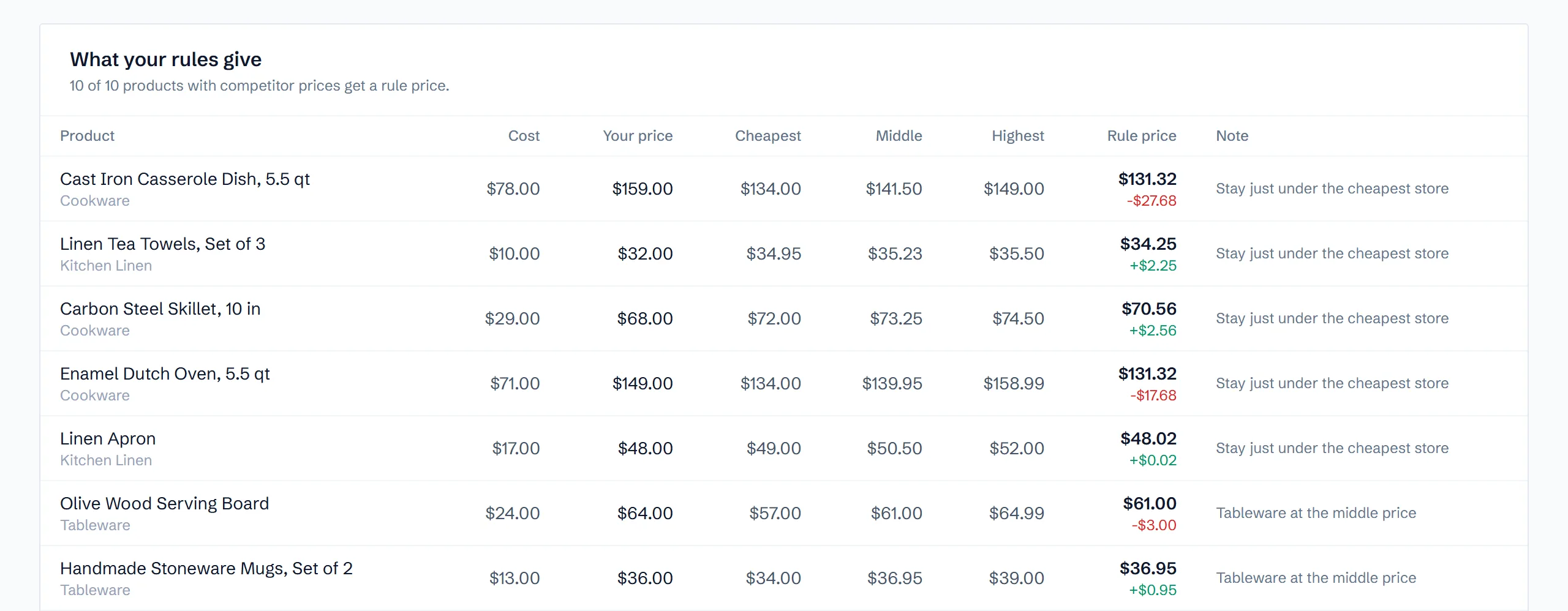
A rule only shows a price; it changes nothing on its own. You apply it on the product's page, and each product's lowest and highest price always hold, which is exactly the guardrail you want during a busy promotion. There is a 14-day free trial that needs no card, so starting it at the beginning of February covers the run-up to the 14th. If you just want a quick look at your current price structure first, the free pricing audit needs no account.
After the 14th
The event is not over when the day ends:
- End the offer when you said you would. Running it on and on teaches customers to wait for your next sale.
- Put prices back. Check that every discounted product and code has been reset.
- Deal with themed leftovers separately. Move hearts-and-roses stock to a clearly marked clearance section. Our guide to clearance sale pricing covers how to do this without training customers to wait.
- Write notes for next year. Which bundles sold, what discount you ran, what rivals did and when. Your baseline and notes make next year's plan much faster.
The same habits work for other gift seasons. If you are planning ahead, see our Christmas pricing guide.
Valentine's Day marketing ideas for small business that support your pricing
Pricing works better when the rest of the store backs it up. A few ideas that help gift buyers say yes at your price:
- Show the delivery cut-off on product pages, in the cart and in emails. A clear date sells more than a vague promise.
- Give your email list early access to bundles before they go public.
- Show the saving on bundles as a plain amount next to the separate prices.
- Photograph the gift wrapped, so shoppers can see what arrives.
- Answer the gift questions up front: returns for gifts, gift receipts, and whether prices appear on the packing slip.
A quick checklist
- Find your last on-time shipping date.
- Work out the full cost of one sale for each product you will push.
- Set a minimum margin per product and write it down.
- Record competitor prices, was-prices and stock about a month out.
- Build two or three bundles and a gift guide by price.
- Choose your offer to match your goal, and limit discounts to products that need them.
- Check rival prices every day or two in the final fortnight, and react with a plan.
- End the offer on time, reset prices, and clear themed stock separately.
Frequently asked questions
When should a small online store start its Valentine's Day promotion?
Work backwards from your last on-time shipping date. Put gift guides and bundles live at normal prices about three weeks out, and keep any discount for the final two weeks before that cut-off.
How much should I discount for Valentine's Day?
Divide your current margin per order by your margin after the discount to see how many times more orders you would need to break even. If that number looks unrealistic, use a smaller discount, a bundle or a gift with purchase instead, and never go below the minimum margin you set.
Are bundles better than discounts for Valentine's Day?
Often they are, because the shopper sees a saving while you get a bigger order and pay for one shipment instead of several. In the worked example, a $55 bundle left more margin than a single item at full price.
Should I match a competitor who cuts prices for Valentine's Day?
Not automatically. Check that it is the same product, that it will arrive in time, that it is in stock and whether the cut is temporary, then respond with a bundle or a small cut that stays above your margin floor if you need to.
What should I do with leftover Valentine's stock?
End the main offer on time, put normal prices back, and move themed leftovers into a clearly marked clearance section so the rest of your range keeps its usual price.