Christmas is the one stretch of the year when your shoppers have a deadline. They are buying for someone else, the gift has to arrive on time, and they can compare you with every other store selling the same thing in a few clicks. That changes what a good price looks like.
A deep discount can fill your order list and still leave you with less money than a quiet November. A well-timed delivery offer can sometimes do more for you than either.
This guide sets out a practical holiday pricing strategy for a small online store. It covers when to start, how deep to discount, how to keep your margin, how to use shipping cut-offs as a pricing lever, and how to watch what competing stores charge before and during the season. Every number in the worked examples is made up to show the arithmetic. Swap in your own.
Start early and plan the season in phases
Christmas pricing works better as a series of small decisions than as one big sale. Split the season into phases so you can change the offer as the shopper's main worry changes. Early on they ask "is this a good price?" Near the end they ask "will it get here in time?"
Before the season
Do the slow work while things are calm, ideally by October or early November:
- Know your numbers per product. Unit cost, packaging, payment fees and what shipping costs you. Without these you cannot tell a profitable discount from a costly one. If you need a refresher, see how to price products.
- Choose what you will discount. Decide now which products get an offer and which stay at full price.
- Record competitors' normal prices. This is your baseline. You need it later to tell a real discount from a raised "was" price.
- Check stock. Only discount products you can deliver. A sale on something you will sell out of in a day just moves profit to the wrong week.
- Note the shipping dates. Carriers publish their last posting dates for the season. Put them in your calendar the day they appear.
Early gift shopping
Someone shopping in early or mid November has time to compare and no deadline pressure. This is a good time for gift guides and bundles, and for small early-bird offers that reward ordering before the rush. You do not need your deepest discount here.
Peak sale days
Black Friday and Cyber Monday fall at the end of November and set the tone for early December. If you run a sale, keep it to the products you chose in advance, with discounts you have already checked against your margin. Decide the end date before it starts.
Shipping cut-off weeks and after
As the last delivery dates get close, a guaranteed arrival date becomes part of the price. After the last cut-off, physical gifts lose much of their value to a Christmas shopper, so your offer should shift to things that still arrive in time. Both are covered in detail below.
Gift products are priced differently
A gift buyer is paying for confidence as much as for the product. Will it arrive on time? Will it look good? Can the person return it if it is wrong? A store that answers those questions clearly can often hold its price against a cheaper store that does not.
It helps to sort your catalogue into three groups:
- Hero gifts. The products people come to you for. Shoppers compare these across stores, so this is where competitor prices matter most and where a sale gets noticed.
- Add-ons and stocking fillers. Lower-priced items that shoppers compare less. They are useful in bundles and for nudging an order over a free-shipping threshold.
- Everyday items. Products people buy for themselves all year. They may not need a Christmas offer at all.
How deep to discount
The useful question is not "what discount looks exciting?" It is "how many more units do I need to sell to make the same profit?" The answer is often more than people expect.
Take an example gift that sells for $40. Here is what that price is made of.
Every dollar you take off the price comes straight out of that $20 margin. The cost of the product does not change because you are having a sale.
| Example offer | Sale price | Margin per unit | Units needed for the same profit |
|---|---|---|---|
| Full price | $40 | $20 | 1x |
| 10% off | $36 | $16 | 1.25x |
| 25% off | $30 | $10 | 2x |
| 40% off | $24 | $4 | 5x |
The rule is simple: units needed = margin before ÷ margin after. At 25% off, this product has to sell twice as many units just to stand still. At 40% off it needs five times as many. Ask yourself honestly whether the discount will do that. If not, the sale makes you busier and poorer.
Set a margin floor before the season
Pick the lowest margin you will accept on each product and write it down. Do it in October, not at 11pm on Cyber Monday when a competitor has just cut their price. A floor turns a stressful decision into a quick check: does this offer stay above the line or not?
Discount the products that can carry it
Good candidates for a discount:
- Products with healthy margins.
- Products where you have plenty of stock to sell through.
- Hero gifts that shoppers compare directly with other stores.
- Seasonal stock that will be worth less on 26 December.
Good candidates to hold at full price:
- Products with thin margins.
- Products few other stores sell, where shoppers have less to compare.
- Products you are short of. Scarce stock does not need help to sell.
Use shipping cut-offs as a pricing lever
Near Christmas, delivery is part of the price. A shopper choosing between a gift that will arrive on time and a cheaper one that might not has a real reason to pay more. That gives you an alternative to a deeper discount: offer free or faster delivery instead.
Using the same $40 example, suppose standard shipping costs you $6 per order and the customer would normally pay it.
Free shipping costs you $6 and keeps $14 of margin. The 25% discount costs you $10 and keeps $10. Whether free shipping wins the same number of orders depends on your shoppers, but in the final weeks a clear "free delivery, arrives before Christmas" can be a strong message on its own.
Build your shipping calendar
- Look up your carriers' published last posting dates for each service and each region you ship to.
- Set your own order-by dates a day or two earlier to allow for packing and pickups.
- Show the order-by date on product pages, in the cart and at checkout.
- Change the message as each date passes, so shoppers never guess.
Price delivery by phase
| Phase | Delivery offer | Price move |
|---|---|---|
| Well before the cut-offs | Normal shipping, or free above an order threshold | Run your planned discounts on chosen products |
| Last week before the standard cut-off | Free standard shipping with a clear order-by date | Often no extra discount needed |
| Between the standard and express cut-offs | Paid express, or free express above a higher threshold | Hold product prices; the shopper is paying for speed |
| After the last express cut-off | Gift cards, digital products, local pickup if you have it | Consider an "arrives after Christmas" offer on physical items |
Express delivery costs you more, so set any free-express threshold high enough that the order's margin covers it. Run the same margin check you used for discounts.
Watch competitor prices before and during the season
Your Christmas prices do not exist on their own. Shoppers see you next to other stores selling the same gift, so you need to know what those stores charge, and what they charged before the season began.
The baseline matters because a "was" price is not always the old price. In this example, a competitor sold the same gift for $39.99 in early November, raised it, and then advertised a sale.
Without the early November figure, this looks like a big cut you must answer. With it, you can see it is a $4 move that lasted about a week.
What to watch
- Prices of your hero gifts at the stores that sell the same product. If you are not sure who those stores are, see how to find your competitors.
- Delivery price and speed, not just the headline price. A cheaper product with expensive or slow shipping may not be cheaper to the shopper.
- Stock. When a competitor runs out of a popular gift, you may not need to discount it at all.
- Markdowns from a "was" price, and when they end.
How to respond without starting a price war
- Do not match every move. Ask whether shoppers really compare this product between you and this store.
- Compare the full cost to the shopper, including delivery, before deciding you are undercut.
- Check your margin floor before you match anything.
- A short sale may end before your change does any good. A one-day dip is often not worth chasing.
- Where you cannot win on price, compete on a delivery date, gift wrapping or easy returns.
The competitor price monitoring guide goes deeper on acting on rivals' moves without a race to the bottom.
Tracking by hand or with a tool
You can do this by hand. Pick your top hero gifts, list the stores that sell each one, and record their price and delivery cost in a spreadsheet at the same time each day through the peak weeks. Competitive pricing analysis in a spreadsheet walks through the layout, and this overview of tracking options compares manual checks, scrapers and tools. The hand method is free but takes time, and time is short in December.
If you would rather not do it by hand, a monitoring tool can do the checking. PriceSway, for example, imports your catalogue from your store URL or a CSV, searches stores across the web for each product to find your competitors, and re-checks tracked prices every day, or every other day once a price has not moved all week. Instead of an alert per change, you get one daily digest of meaningful moves, at least your change threshold (10% by default). It also flags competitors' markdowns from a was-price, out-of-stock and back-in-stock changes, and upcoming sale days in your market. Its market position screen shows a competitive health score, your biggest price gaps and recent competitor price changes in one place.
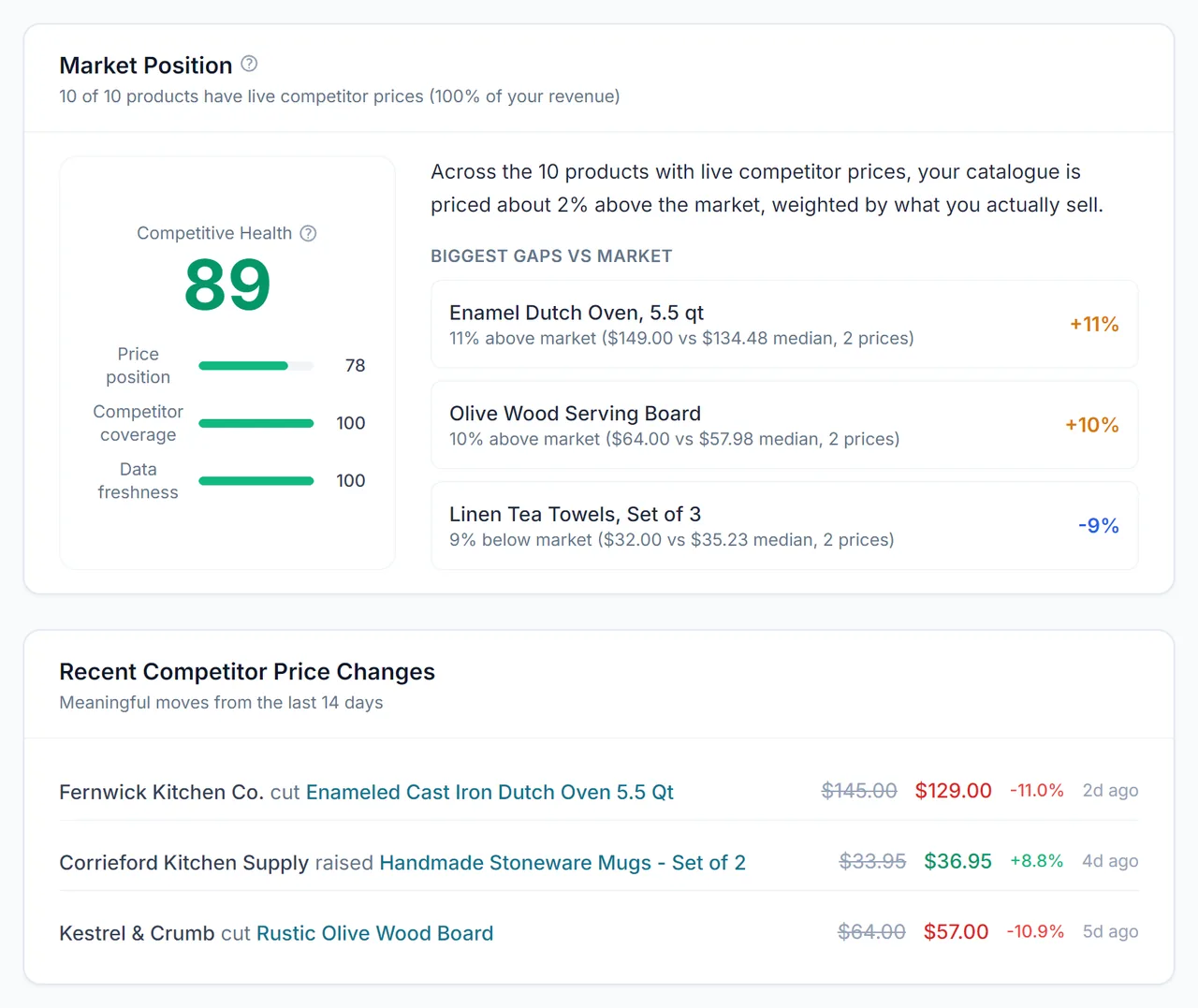
Plans start at US$49 a month with a 7-day free trial; there is no free plan for new accounts. Other tools suit other stores. Prisync is a mature option for rule-based repricing across larger catalogues and marketplace channels. Priceva had a free plan for up to 20 products and 20 competitor sites when we checked in November 2026, which suits a small store that already knows who to watch. Price2Spy is built for MAP enforcement and enterprise volume. The comparison pages set out where each one is stronger. If you just want a quick look at your own price structure before the season, the free pricing audit needs no account.
Christmas sale ideas that protect your margin
A percentage off is only one way to give a shopper a reason to buy. These Christmas sale ideas give value while keeping more of your margin:
- Gift bundles. Pair a hero gift with an add-on at a price below the two bought separately. The saving is real to the shopper, and the add-on's margin pays for it.
- A free-shipping threshold. Set it a little above your typical order value so shoppers add a stocking filler to reach it.
- Gift with purchase. A small, low-cost item above a spend level can feel more generous than a few dollars off.
- Free gift wrapping or a handwritten note. It costs you little and answers the gift buyer's real worry.
- Early-bird offers. A modest offer for ordering before the peak weeks spreads your packing load.
- Second item offers. A discount on a second item lifts order value without cutting the price of the first.
- First access for past customers. Email your list before the public sale. People who already trust you may not need the deepest discount.
- Gift cards. Your best product after the last shipping date. Nothing to pack, nothing to ship.
After Christmas: clear, reset, review
- Clear seasonal stock quickly. Christmas-themed items lose value fast after the day. Discounting them early in the new year usually beats storing them for eleven months.
- Put regular products back to full price. Leaving a Christmas discount running teaches shoppers to wait for one.
- Review the numbers. For each discount, did the extra units cover the lost margin? Which competitor moves actually changed your sales, and which could you have ignored?
- Write notes for next year. Your carriers' dates, your best bundles, your order-by messages and what you would change. Next October you will be glad you did.
A short checklist
- Know your cost, fees and shipping cost for every product you might discount.
- Set a margin floor per product.
- Record competitors' normal prices before the season.
- Choose which products get offers and how deep, using the units-needed rule.
- Put carriers' last posting dates in a calendar and set your own order-by dates earlier.
- Plan delivery offers for each phase.
- Watch your hero gifts' competitor prices, delivery and stock through the peak weeks.
- Switch to gift cards and digital options after the last cut-off.
- Clear seasonal stock, reset prices and write up what worked.
Frequently asked questions
When should an online store start its Christmas pricing?
Start preparing in October or early November: know your product costs, set margin floors, choose which products get offers and record competitors' normal prices. That baseline lets you spot inflated was-prices once the sales begin.
How much should I discount for Christmas?
Work out how many more units you need to sell to make the same profit: margin before divided by margin after. In the article's example, a 25% discount halves the margin, so you would need to sell twice as many units just to break even on profit.
Is free shipping better than a discount at Christmas?
It can be cheaper for you. In the example, free shipping costs $6 and keeps $14 of margin, while 25% off costs $10. Close to the shipping cut-offs, a guaranteed arrival date can matter to gift buyers as much as a lower price.
What should I offer after the last Christmas shipping date?
Switch the focus to gift cards, digital products and local pickup if you have it. For physical items, a clearly labelled arrives-after-Christmas offer is an option, since the gift deadline has passed.
Should I match a competitor's Christmas sale?
Not automatically. Check whether shoppers really compare that product between you, compare the full price including delivery, and make sure a match stays above your margin floor. Short sales often end before a price change does you any good.