A clearance sale has one job: turn stock you no longer want into cash, at the best price you can still get for it. The risk is that it also does a job you never asked for. If customers learn that your products always end up heavily discounted after the season, they stop paying full price during the season.
This guide covers clearance sale pricing for a small online store. It explains what to clear and what to hold, how deep to discount, and how to plan markdowns over a few weeks. It also covers how to check what competing stores charge before and during the sale. All prices below are made-up examples.
How a clearance sale teaches customers to wait
Customers learn from patterns. Three patterns teach them that waiting pays.
- Discounting things you will restock. If your best-selling item goes on clearance and is back at full price a month later, buyers remember. Next time they wait.
- Sales with no pattern. If a discount can appear at any time, every full-price purchase feels like a gamble. A buyer who has been burned once will hold off.
- Prices that bounce. If an item is cleared, sold out, restocked at full price and then cleared again, the full price stops meaning anything.
The fix is a simple rule: clearance is for stock that is leaving your range. If you plan to reorder an item, it does not go in the clearance section. If it needs a lower price, change its regular price and leave it at that. If you want to promote it, use a short, clearly framed promotion instead of a clearance tag.
Decide what to clear and what to hold
Go through your stock item by item before you set any prices. Sort each one into one of two groups.
Clear
- Discontinued or end-of-line items. Products you will not buy again, last season's colours or designs, old versions of something you have replaced.
- Broken size or colour runs. A jacket with only extra-small and extra-large left will not sell at full price. Shoppers looking for a medium leave.
- Slow movers tying up cash and space. Items that have sat for a long time with no reason to think next season will be different.
- Anything that dates. Products with an expiry date, a printed year, or a trend that is fading.
Hold
- Core lines you reorder. Keep these out of clearance completely, for the reasons above.
- Seasonal stock that stores cheaply and will sell at full price next year. Compare what it costs to keep it (storage, the cash tied up) with what you would give away by discounting it now. A box of plain winter scarves that costs little to store may be worth more held than cleared.
- New arrivals. Even if they started slowly, give them a fair run first.
- Items where you are already the cheapest seller. Cutting further mostly hands margin to buyers who would have bought anyway.
A quick test for each item: would I buy this again at today's cost? If the answer is no, clear it. If the answer is yes, the item probably has a price or visibility problem, not a stock problem. Clearance is the wrong tool for that.
Check competitor prices before you cut anything
Before you mark anything down, find out why it is slow. An item can sit for two very different reasons. Either the season has passed, or other stores sell the same thing for less at full price. Clearance fixes the first. For the second, it just gives away margin.
Here is an example. You sell a wool throw blanket at $60. You search for the same product and find four other stores selling it.
Three of the four stores are cheaper than you, before anyone runs a sale. Store A is at $49. If you take 15% off for clearance, your price becomes $51, which is still above Store A's regular price. Your "sale" would not look like a deal to anyone who compares.
What this tells you:
- If the item is a core line, do not clear it. Move its regular price closer to the market, for example somewhere near Store B. Leave it there without a sale label.
- If the item is leaving your range, go ahead with clearance. Plan your steps knowing where the market sits, so your first markdown actually lands below the stores shoppers compare you with.
- If competitors are already running an end of season sale, note how deep they went and on what. You do not have to match them. You should know what your clearance price is up against, though.
- If competitors have sold out, you may be able to sell your remaining units with little or no discount. Check stock as well as price.
For a short list of items, you can check this by hand in an afternoon. Search each product and note every store that sells it, with its price, delivery cost, stock status and any crossed-out was-price. The competitive pricing analysis guide shows how to lay this out in a spreadsheet. If you are not sure who your competitors are product by product, start with how to find your competitors.
With more items, the hand checks get slow. A monitoring tool can do the searching for you. PriceSway, for example, imports your catalogue from your store URL or a CSV. It searches the web for each product and shows the other sellers found online, with their price and delivery and where your price ranks among them. If you want a quick look before committing to anything, the free pricing audit shows a store's price structure with no account.
How deep to discount: start from the floor
The most common way to lose money on clearance is to pick the discount first and do the maths later. Do it the other way round. Work out the lowest price you will accept for each item, then plan your steps down towards it.
Work out break-even
For each item, add up:
- What the unit cost you, including inbound shipping and duties.
- Outbound shipping you pay, if you offer free delivery.
- Payment and platform fees at the clearance price.
- Packaging, if it is a real cost per order.
In the blanket example, the unit cost $24, you pay $6 to ship it, and fees come to about $1.10 at clearance prices. Break-even is about $31.10. You set your floor at $34, which still leaves a little on each sale.
Should the floor ever go below break-even?
The money you paid for the stock is already spent. For very old stock, the honest question is whether a sale brings in more cash than it costs you to ship. Sometimes selling below break-even beats paying to store something for another year. Before you publicly crash a price, though, look at quieter options:
- Bundle the item with something that sells well.
- Offer it as a free gift above a basket value.
- Sell the remaining units in one lot to a reseller.
- Donate it, if that suits your business.
These clear stock without putting a very low price on your site for every shopper to see and remember.
Keep the first step small
Your first markdown is the one most likely to be taken by people who would have paid full price anyway. Make it just big enough to land below the stores you compete with. How fast you go deeper after that depends on how much stock you have and how many weeks you are willing to spend.
A markdown plan over four to five weeks
A planned ladder stops you making panicked cuts halfway through. Decide the steps and the floor before the sale starts. Then move each item down only when it is selling slower than you need.
Here is the blanket again. You have 40 units and want them gone in about five weeks, so you need to sell roughly 8 a week.
| Week | Price | Off full price | What you do |
|---|---|---|---|
| 1 | $60 | 0% | Check competitor prices and stock, set the ladder |
| 2 | $51 | 15% | First markdown, clearance section only |
| 3 | $45 | 25% | Only if week 2 sold fewer than planned |
| 4 | $39 | 35% | Only if still behind |
| 5 | $34 | about 43% | Floor, final sale, then bundle or sell the rest in one lot |
Note that in this example the week 2 price of $51 is still above Store A's $49. If Store A is the store your shoppers compare with, you might start at $45 instead and drop the $51 step. That is the kind of decision the competitor check in week 1 is for.
A few rules that keep the ladder working:
- Mark down item by item, not storewide. If the grey blanket sells 10 units at $51 and the green one sells 2, only the green one moves down.
- Do not go deeper on something that is selling. If an item is on pace at the current step, leave it there.
- Prices only go down during clearance. Never raise a cleared item back to full price and then mark it down again.
- When it is gone, it is gone. Do not restock the same item at full price soon after clearing it. That is the quickest way to teach buyers to wait.
Protect margin and full-price trust
The ladder protects your margin on the clearance items. These habits protect the full price on everything else.
- Keep clearance in its own section. Label it clearly as end-of-line stock. Core products never appear there.
- Use honest was-prices. Only show a crossed-out price you actually charged for a real period before the sale. Rules on reference prices differ by country, so check the consumer rules where you sell.
- Run clearance at a predictable time. One or two set points a year, such as after your peak season, read as a normal end of season sale. Discounts that appear at random read as "never pay full price here."
- Make the trade-off visible. Clearance items can be final sale or have limited returns, if your local rules allow it. State this plainly on the product page. Shoppers then see a real difference between a clearance purchase and a full-price one.
- Be careful about announcing the ladder. Telling shoppers "prices drop every week" creates urgency when stock is thin, such as odd sizes or a handful of units. With deep stock, it tells them exactly how long to wait.
- Do not lead every email with a discount. Send clearance to people likely to want it. Keep your regular emails about the products, not the percentage off.
If you are also planning gift-season prices, the Christmas pricing guide covers the run-up to the period when many end of season sales start. For setting regular prices in the first place, see how to price products.
Watch competitors during the sale
The market does not stand still while your clearance runs. Before each step down, check three things.
- Has a competitor started its own markdown? If a store now sells the same item below your clearance price, decide whether to follow. Compare stock levels. If they clearly have far more units than you, chasing them to your floor can cost you margin without moving many more items.
- Has a competitor sold out? If the cheaper stores are out of stock, you may not need your next step at all. Pause and see whether sales pick up at your current price.
- Has a new seller appeared? A new store at a low price can change what counts as a deal. It is better to know before you set next week's price than after.
For a handful of items, a weekly check by hand before each step is enough. Use the same spreadsheet you built in week 1 and add a column per week. With dozens of items, daily changes are easy to miss. That is where a monitoring tool earns its place. The competitor price monitoring guide explains what to look for in one, and the comparison page sets PriceSway against other tools, including where they are the better fit.
In PriceSway, tracked competitor prices are re-checked every day or two. Changes arrive in a single daily digest email. The digest covers competitor markdowns from a was-price, items going out of stock and coming back, new sellers, and when you became or stopped being the cheapest seller. It also lists upcoming sale days in your market. The market position view puts this together for each store: a competitive health score, your biggest price gaps and recent competitor price changes.
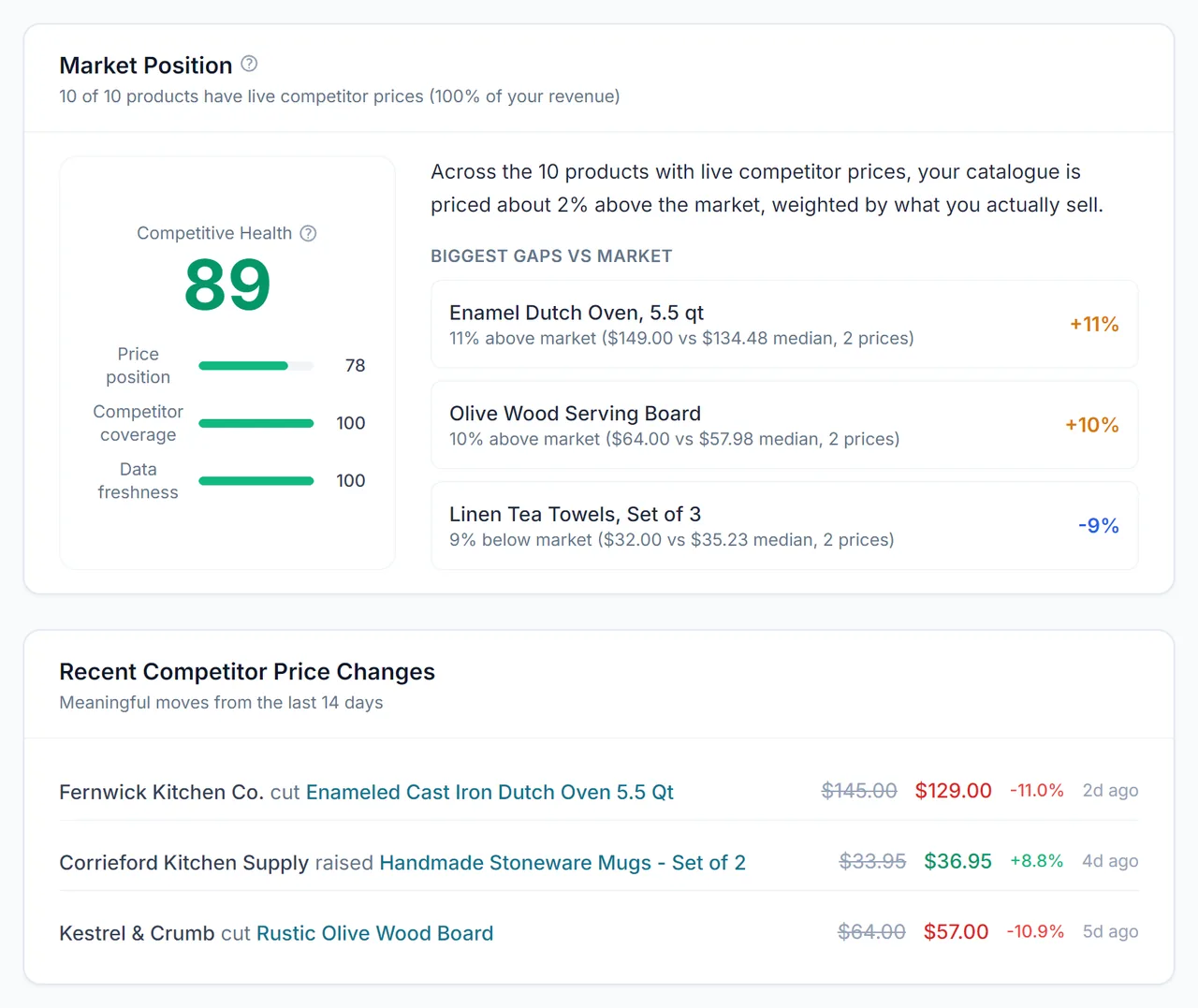
Its price recommendations also respect a minimum-margin floor that you set. A suggestion will not go below the margin you have decided you can live with, which fits the floor-first approach above. Plans start at US$49 a month with a 7-day free trial, and there is no free plan for new accounts. The manual method works fine if your list is short.
After the sale: learn for next time
When the clearance ends, spend half an hour on what it taught you.
- Which items sold at the first step? These may not have needed clearance at all. Next season, buy a little more of them, or keep them as a core line.
- Which items needed the floor or below? Buy fewer of these, or do not buy them again.
- Were you above the market before the sale started? If so, fix regular prices earlier next year. That way fewer items reach clearance in the first place.
- When did competitors start their end of season sales, and how deep did they go? Write it down. Next year you can time your first step around theirs instead of reacting to it.
- Did any core items slip into clearance? If so, make sure they come back at a fair regular price and not straight back to the old one.
A clearance sale goes well when it clears what it should and leaves the rest of your prices believable. Keep it to stock that is leaving, check the market before you cut, plan steps down to a floor, and only move when sales are behind.
Frequently asked questions
How much should I discount clearance items?
Start from your floor, not a percentage. Work out what each unit cost plus shipping and fees, set the lowest price you will accept, then plan a few steps down to it. Make the first step just big enough to land below the stores your shoppers compare you with.
How do I run a clearance sale without customers waiting for discounts?
Only clear stock that is leaving your range, and keep core products out of it. Run clearance at a predictable time, such as one end of season sale. Never restock a cleared item at full price soon after.
When should I start an end of season sale?
Start once full-price demand for the season has clearly passed. Check competitor prices first, because if other stores already sell an item for less at full price, the problem is your regular price, not the season.
How long should a clearance sale last?
Long enough to step down gradually, often a few weeks, with each item moving down only when it sells slower than planned. Set the steps and the floor before you start so you do not make panicked cuts halfway through.
Should I check competitor prices before a clearance sale?
Yes. If competitors are already cheaper at full price, a small clearance discount may still leave you above them. If they have sold out, you may not need to discount much at all.