Pricing a product comes down to three questions, asked in order. What does each sale really cost you? What do shoppers see when they compare you with other stores? And how do your own customers react when the price moves? Skip the first and you can sell a lot and still lose money. Skip the second and you price yourself out of the comparison. Skip the third and you never find out whether a different price would earn more.
This guide walks through all three, with a worked example you can copy into a spreadsheet. It works for a brand new store, a store adding a new product, or one that has never looked hard at its prices.
Step 1: Work out what each sale really costs
Your price has to cover more than what you paid the supplier. List every cost that comes with a sale, then every cost you pay whether you sell or not.
Landed cost per unit
This is what one unit costs you by the time it is on your shelf, ready to ship:
- The supplier's price per unit
- Inbound freight, split across the units in the shipment
- Import duties and customs fees, if any
- Packaging, labels and inserts
If you dropship, the landed cost is usually the supplier's price plus whatever they charge to ship to your customer.
Costs per order
These come with every sale but are easy to forget:
- Payment processing fees (usually a percentage plus a fixed amount per order - check your own processor's rates)
- Marketplace or platform transaction fees, if you pay them
- Any part of shipping you pay instead of the customer
- An allowance for returns, refunds and damaged goods
- Ad spend per order, if you pay to get traffic
Fixed costs
These are the monthly bills that do not change with each order: your store platform, apps, software subscriptions, storage, and your own time if you want to pay yourself. You do not add these to each unit directly. Instead, you check how many orders you need each month to cover them.
Step 2: Turn costs into a price floor (worked example)
The numbers below are made up for illustration. Swap in your own.
Say you sell a scented candle.
| Cost | Amount (example) |
|---|---|
| Supplier price | $8.00 |
| Inbound freight per unit | $1.00 |
| Packaging | $1.50 |
| Landed cost | $10.50 |
| Payment fee (example: 3% + $0.30) | depends on price |
| Shipping you absorb per order | $2.00 |
| Returns allowance per order | $0.50 |
| Ad spend per order | $6.00 |
| Fixed costs per month | $800 |
Margin vs markup
These two get mixed up all the time, and the mix-up leads to underpricing.
- Markup is profit as a share of cost. Selling the $10.50 candle at $24 is a markup of about 129%.
- Gross margin is profit as a share of price. The same $24 sale has a gross margin of about 56% ($13.50 out of $24).
If you want a target gross margin, the formula is: price = landed cost / (1 - target margin). For a 50% gross margin on $10.50, that is $10.50 / 0.5 = $21.
Contribution per order
Gross margin only counts the landed cost. Now take off the per-order costs to see what each sale actually contributes to your fixed bills.
| Price $24 | Price $28 | |
|---|---|---|
| Landed cost | $10.50 | $10.50 |
| Payment fee | $1.02 | $1.14 |
| Shipping absorbed | $2.00 | $2.00 |
| Returns allowance | $0.50 | $0.50 |
| Ad spend | $6.00 | $6.00 |
| Contribution per order | $3.98 | $7.86 |
| Orders to cover $800 fixed costs | about 200 | about 102 |
At $24 the candle looks healthy on gross margin, but after ads and fees you need roughly twice as many orders to break even as you would at $28. That is the point of this step: you now know your floor, and you know how much each extra dollar of price is worth.
Write down two numbers for each product before moving on:
- The lowest price you will accept - the point where contribution stops being worth it.
- The price that hits your target margin after per-order costs.
Step 3: See what the market charges in your price band
Costs tell you the lowest you can go. The market tells you what shoppers will compare you with. A good ecommerce pricing strategy looks at both.
Find the stores a shopper actually sees
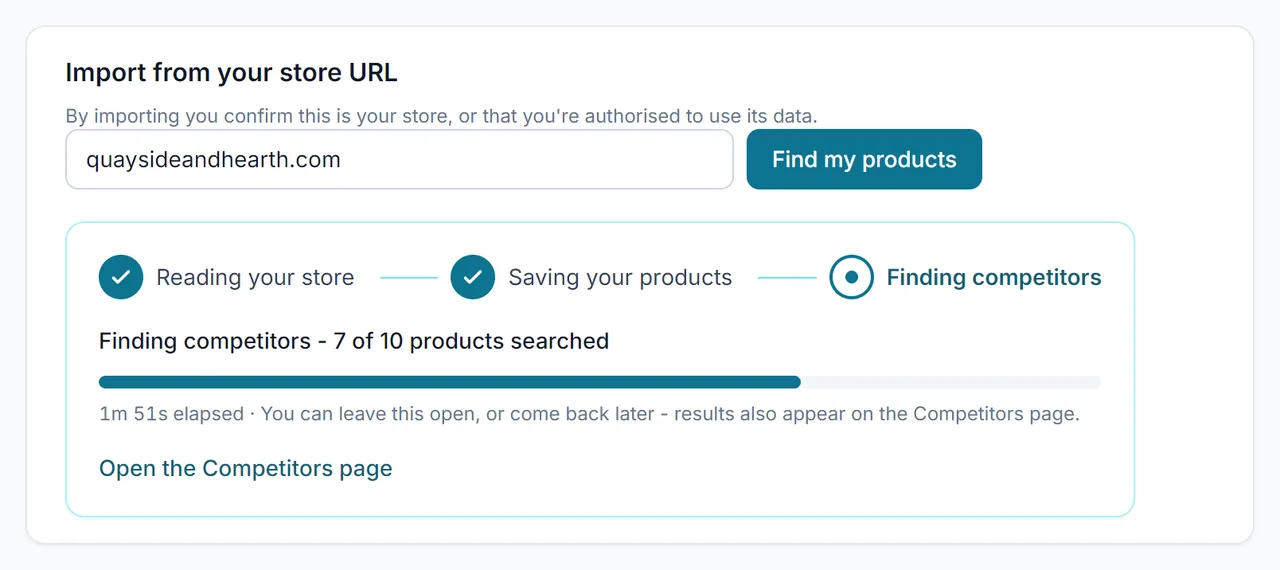
Your competitors are not just the big names in your niche. They are whoever shows up next to you when a shopper searches for that product. Search for each of your key products the way a customer would and note the stores that keep appearing. Our guide on how to find your competitors covers this step in detail.
Stay in a realistic price band
Compare with alternatives a shopper would genuinely consider. A $40 candle is not competing with a $3 tea light or a $400 designer one. A workable rule of thumb is to look at options between about half and twice your price - that is the band PriceSway uses when it searches the web for each of your products.
Compare the total price, not just the sticker
For each competitor, note:
- The product price
- The delivery charge, and the free-shipping threshold if there is one
- Whether the price is a markdown from a higher was-price
- Whether it is in stock
- The date you checked
A rival at $22 with $6 delivery is more expensive than you at $26 with free delivery. A rival on a short-term sale is not a reason to cut your regular price. And a rival that is out of stock is not competing with you this week at all.
Decide where you want to sit
Once you have the range, choose your position on purpose:
- Below the market works if your costs are genuinely lower and you can hold it. If not, it is a margin you are giving away.
- At the market is a sensible default when your product and service look much the same as everyone else's.
- Above the market needs a reason a shopper can see: faster shipping, better photos and descriptions, bundles, a stronger guarantee, better reviews or a brand they trust.
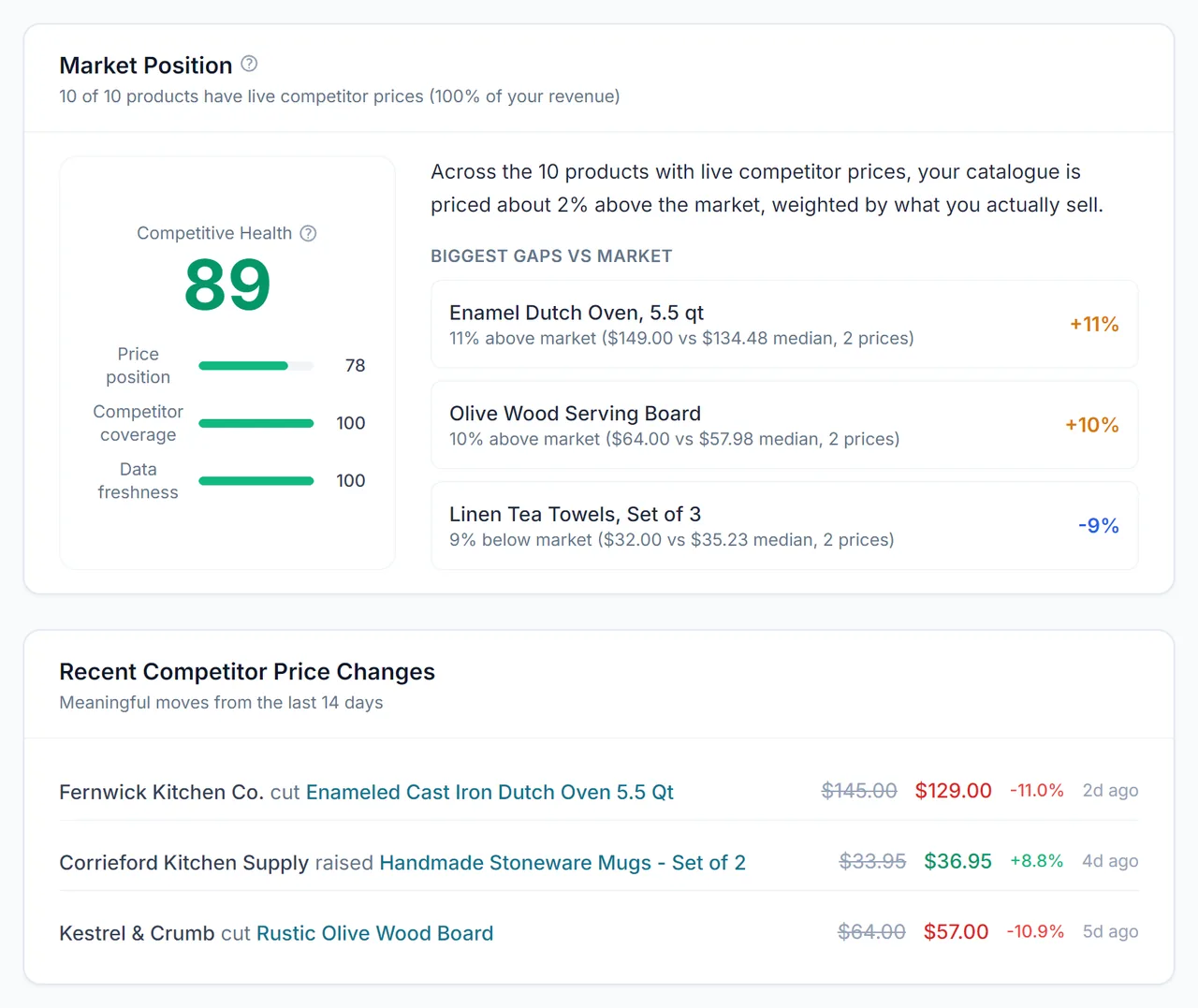
If your price floor from Step 2 sits above what the whole market charges, that is useful to learn now. Your options are to lower costs, find a way to justify a higher price, or not sell that product.
Common pricing approaches for a small business
Most small business pricing strategy comes down to a blend of these:
| Approach | How it works | Good for | Watch out for |
|---|---|---|---|
| Cost-plus | Add a fixed markup to landed cost | Speed, unique products with no direct rivals | Ignores what shoppers will pay and what rivals charge |
| Competitor-based | Price relative to the market | Products widely sold online | Can drag you below your floor; ties you to rivals' mistakes |
| Value-based | Price on what the product is worth to the buyer | Distinct, branded or hard-to-compare products | Needs real evidence of that value |
| Premium | Price above the market and support it | Strong brand, better service or quality | Must be backed by something visible |
| Penetration | Start low to win early customers, then raise | Building reviews on a new product | Raising prices later can be hard |
The safest habit is to use cost-plus to set the floor, the market to set the range, and testing to find the best point inside that range.
Pricing a new product
A new product pricing strategy has one extra problem: you have no sales history. Here is a practical order of work.
Work backwards before you buy stock
Start from what the market charges, then work out the most you can pay per unit and still hit your margin. Using the formula from Step 2 in reverse: maximum landed cost = expected price x (1 - target margin). If similar products sell for around $30 and you want a 50% gross margin, you cannot pay more than $15 landed. Then check your per-order costs leave enough contribution.
If you have not chosen what to sell yet, PriceSway's product research does this calculation for you: you give it a niche, countries and a price range, and it returns product ideas with a suggested price, the most to pay per unit for a 40% gross margin, and the competition found online. You can also do the same work by hand with searches and a spreadsheet.
Launch at a price you can defend
It is usually easier to run a launch discount off a full price than to raise a price shoppers have already seen. If you launch low to win early reviews, call it a launch price and give it an end date, so the later price is not a surprise.
Plan your first test now
Pick the price you will try second before you launch. That way you collect useful data from day one instead of deciding later.
Price elasticity in plain words
Price elasticity is how much your sales move when your price moves.
- If you raise the price a little and sales barely drop, demand is inelastic. Your customers are not very price-sensitive, and a higher price probably earns you more.
- If you raise the price a little and sales drop a lot, demand is elastic. Customers are comparing hard, and a lower price may earn you more in total.
Here is a made-up example. You raise the candle from $24 to $26 and weekly sales go from 50 to 47. Revenue goes from $1,200 to $1,222. More importantly, using the contribution figures from Step 2, each order now contributes about $2 more, so total contribution rises clearly even though you sold three fewer. Had sales dropped from 50 to 35, the same price rise would have cost you money.
Two things are worth remembering:
- Elasticity is about your customers, not the market in general. Two stores selling the same product can see different reactions, because their traffic, trust and service differ.
- Aim for profit, not revenue. A lower price can raise revenue and still cut profit. Always judge a price by contribution per day or week.
If you want to see how a tool estimates elasticity, our methodology page explains how PriceSway does it: it fits a demand model to the prices you have charged and the units you sold at each, gives a best estimate with a band of uncertainty, and starts new products from a reference elasticity (about -1.3 for most product groups) that is labelled an estimate until your own sales replace it. It never recommends a price below your minimum margin.
Step 4: Test a price and watch sales
You do not need special software to test prices. You need discipline.
How to run a simple price test
- Pick a product with steady sales. A product that sells once a month will not tell you anything quickly.
- Record a baseline. Note units sold, visitors to the product page, conversion rate and contribution per week at the current price.
- Change only the price. Leave photos, description, shipping and ads alone during the test.
- Move by a meaningful step. A change so small no one notices tells you nothing. Stay above your floor.
- Run it long enough. Compare like with like - full weeks against full weeks, so weekday and weekend patterns cancel out.
- Avoid distortions. Do not test across big sale days, holidays, a new ad campaign or a stockout.
- Watch the market while you test. If a competitor starts a sale or runs out of stock mid-test, your results are affected. Note it.
- Judge on contribution. Keep the new price if it earns more per week, even with fewer orders. Roll back if it earns less.
When sales are too thin to test one product
Test a group instead. Move the price of several similar products in the same direction and compare the group's total contribution before and after. It is less precise but far better than guessing.
Keep a pricing log
A simple sheet with the date, product, old price, new price, reason and result becomes very valuable over time. It stops you repeating failed tests and shows which products have room to move.
Step 5: Keep your prices current
A price that was right in spring can be wrong by autumn. Supplier costs change, freight changes, and competitors move their prices, run sales and drop out.
Review on a schedule
- Costs: recheck landed cost whenever you reorder.
- Market: recheck competitor prices for your best sellers regularly, and before any big sale period.
- Results: review your pricing log each month and pick the next products to test.
Manual checks or a tool
For a handful of products, a spreadsheet and a regular round of searches is enough. As your catalogue grows, checking by hand gets slow and easy to skip. Our guide to tracking competitor prices compares manual checks, spreadsheets, scrapers and dedicated tools, and the competitor price monitoring guide covers how to react to a rival's move without starting a price war.
If you look at tools, each suits a different store:
- Priceva has a real free plan (up to 20 products and 20 competitor sites, as checked against its pricing page in November 2026), which suits a small catalogue when you already know which sites to watch. It also covers MAP monitoring.
- Prisync is mature monitoring with rule-based repricing and marketplace channel plans, from $99/mo for 100 products as checked in November 2026. It suits large catalogues where you want hands-off rules.
- Price2Spy is deep URL monitoring with MAP enforcement and screenshot evidence, priced by quote. It suits brands policing resellers and larger teams.
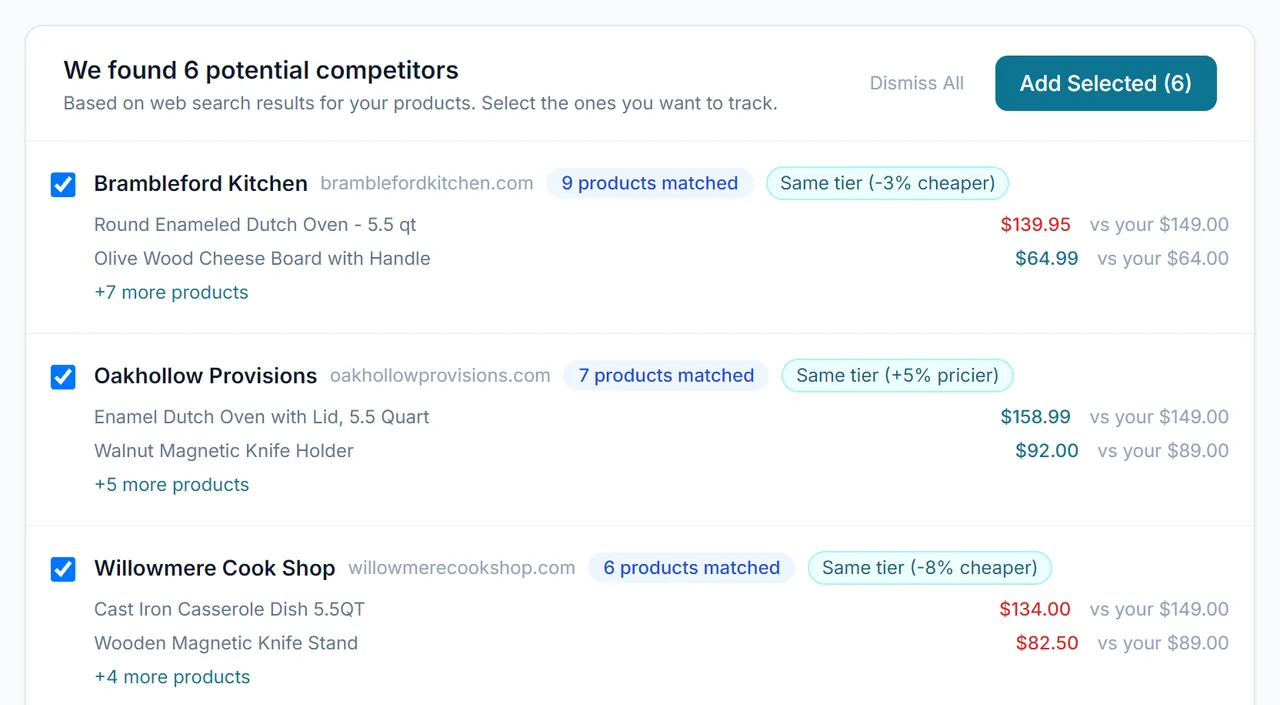
- PriceSway finds competitors from your own catalogue rather than asking you for competitor URLs, rechecks prices about once a day, and gives price recommendations from a demand model. Plans start at US$49/mo with a 3-day free trial; there is no free plan.
Our comparison page sets out where each one is stronger. If you just want a quick look at your current price structure, the free pricing audit needs only your store URL and no account.
Common pricing mistakes to avoid
- Pricing on supplier cost alone. Fees, shipping, returns and ads can swallow a margin that looked fine.
- Copying the cheapest rival. Their costs and goals are not yours, and the cheapest store is not always the one making money.
- Reacting to every competitor sale. A temporary markdown is not a new market price.
- Comparing sticker prices only. Shoppers compare the total with delivery.
- Never testing. Without a test, you never learn whether a higher price would earn more.
- Judging by revenue. Contribution per week is the number that pays your bills.
A simple checklist
- List landed cost and per-order costs for each product.
- Calculate your floor and your target-margin price.
- Check what rivals charge in your price band, including delivery.
- Choose a position - below, at or above the market - with a reason.
- Set the price, log it, and plan a test.
- Judge results on contribution, then repeat.
Do this for your best sellers first. Those are the products where getting the price right makes the biggest difference.
Frequently asked questions
What is the simplest way to price a product for an online store?
Work out the landed cost plus per-order costs like fees, shipping and ads, then set a price that hits your target margin. Check that price against what other stores charge for similar products, including delivery, and adjust within that range.
What is the difference between markup and margin?
Markup is profit as a share of cost, while gross margin is profit as a share of the selling price. To price for a target gross margin, divide your landed cost by one minus the margin, so a 50% margin on a $10.50 cost means a $21 price.
How should I price a new product with no sales history?
Start from what the market charges for similar products, work backwards to the most you can pay per unit and still hit your margin, and launch at a price you can defend. Plan a price test from the start so your first weeks of sales tell you something.
What is price elasticity?
It is how much your sales change when your price changes. If sales barely drop after a price rise, demand is inelastic and a higher price likely earns more; if sales fall sharply, demand is elastic and you may do better at a lower price.
Should I always match my cheapest competitor?
No. Their costs and goals may differ from yours, and matching can push you below your price floor. Compare total prices with delivery, ignore short-term sales, and only compete on price where your costs allow it.
How long should a price test run?
Long enough to compare full weeks with full weeks, so weekday and weekend patterns even out, and longer for slow sellers. Avoid running tests across big sale days, stockouts or new ad campaigns, and judge the result on contribution rather than units.