Picking competitor price monitoring software for a small online store comes down to a few practical questions. Who does the work of finding your competitors? What does the tool tell you after a price changes? And what will you actually pay once add-ons are counted?
This guide starts with what to look for in any tool. Then it compares four options: PriceSway, Prisync, Priceva and Price2Spy. Each rival's pricing comes from its own pricing page, checked in November 2026. Prices change, so check again before you buy.
A disclosure up front: we make PriceSway. We have tried to say plainly where each of the other tools is the better pick, and this guide should still help you if you never sign up for ours.
What to look for in a competitor price monitoring tool
Feature lists are long, but a few questions decide whether a tool will work for a small store.
Who finds the competitors
This is the biggest difference between tools and the one people check last. Some price monitoring software only watches the competitor sites or product URLs you give it. That means you must already know who your competitors are, and find each matching product page yourself.
For a store with a few dozen products and two obvious rivals, that is fine. For a bigger catalogue it turns into a real project. Prisync's own model makes the point: a 200-product store watching five competitors can have up to a thousand product pages to find and keep current.
If you do not have a competitor list yet, either pick a tool that builds one for you, or build it by hand first. Our guide on how to find your competitors shows how to do that in an afternoon.
How products get matched
Once you know a competitor, the tool has to link each of their products to yours. Ask three things:
- Is matching included, manual, or a paid add-on?
- Is the add-on priced per site or per match? Per-site pricing grows with every competitor you add.
- Can you see why two products were matched, so you can catch mistakes?
A bad match is worse than no match. It makes you react to a price for a different product.
How often prices are checked
Options range from about once a day to several times a day. A daily check is enough to catch lasting price changes and sales. More frequent checks matter if your competitors reprice within the day, or if you sell in fast-moving categories. Do not pay for frequency you will not act on.
Also check what happens when a check fails. A tool should flag a broken or stale price rather than quietly show yesterday's number as if it were current.
How changes reach you
An alert for every small change gets ignored within a week. Look for a change threshold you can set, and some way to batch changes into a summary. It also helps if the tool can tell a short promotion apart from a lasting price move.
What happens after a price changes
Tools take three broad approaches:
- Data only. You get alerts, dashboards and reports. Deciding what to do is your job.
- Rules or formulas. You write something like "match the lowest competitor minus 5%" and the tool applies it. Fast and hands-off, but the rule is your guess about how customers respond.
- Recommendations. The tool suggests a price and estimates what it will do to revenue or profit, ideally based on your own sales.
None is right for everyone. A store with thousands of products on marketplaces may want rules. An owner without time to analyse every move may want a recommendation.
MAP and marketplaces
If you are a brand making sure resellers respect a minimum advertised price (MAP), you need MAP monitoring, and possibly screenshot evidence. If you sell mainly on marketplaces, check the tool covers them. If you are a retailer selling on your own site, you may need neither.
How the price is structured
Look past the headline price:
- Per-product tiers mean you pay for capacity whether you use it or not.
- Add-ons for matching, API access, extra sites or extra channels can cost more than the base plan.
- Quoted pricing means you cannot compare until you talk to sales.
Work out the full monthly cost for your actual catalogue and competitor count before comparing.
Trial, setup and platform
Check how long the trial is, whether it needs a card, and whether you can import your catalogue from your store platform or a CSV. A trial is only useful if you can get your real products in quickly.
Quick comparison
Rival details as listed on each tool's pricing page in November 2026.
| PriceSway | Prisync | Priceva | Price2Spy | |
|---|---|---|---|---|
| Entry price | US$49/mo | $99/mo (URL-based, 100 products) | Free (20 products, 20 sites) | Quoted, not published |
| Trial or free option | 3-day free trial | 14-day free trial, no card | Free plan; no standard self-serve trial listed | Free trial on Starter and Basic |
| Who finds competitors | Found automatically from your catalogue | You add URLs or set up channels | You configure the sites | You supply the URLs |
| Product matching | Included | Part of your URL setup | Manual, or paid add-on | Automatch is a paid add-on |
| Check frequency | About once a day | Up to 3 times a day on URL plans; daily on channels | Daily, with monthly check quotas | Up to 8 a day on top tiers |
| After a change | Price recommendation with expected revenue change | Rule-based repricing | Formula-based repricing | Repricing module sold separately |
| MAP monitoring | No | Not covered in our comparison | Yes | Yes, with screenshots |
| API | No public API | Extra 20% on subscription | Not covered in our comparison | On Premium |
PriceSway
PriceSway is a competitor price tracker and product research tool for small and mid-size online stores on any platform.
What it does
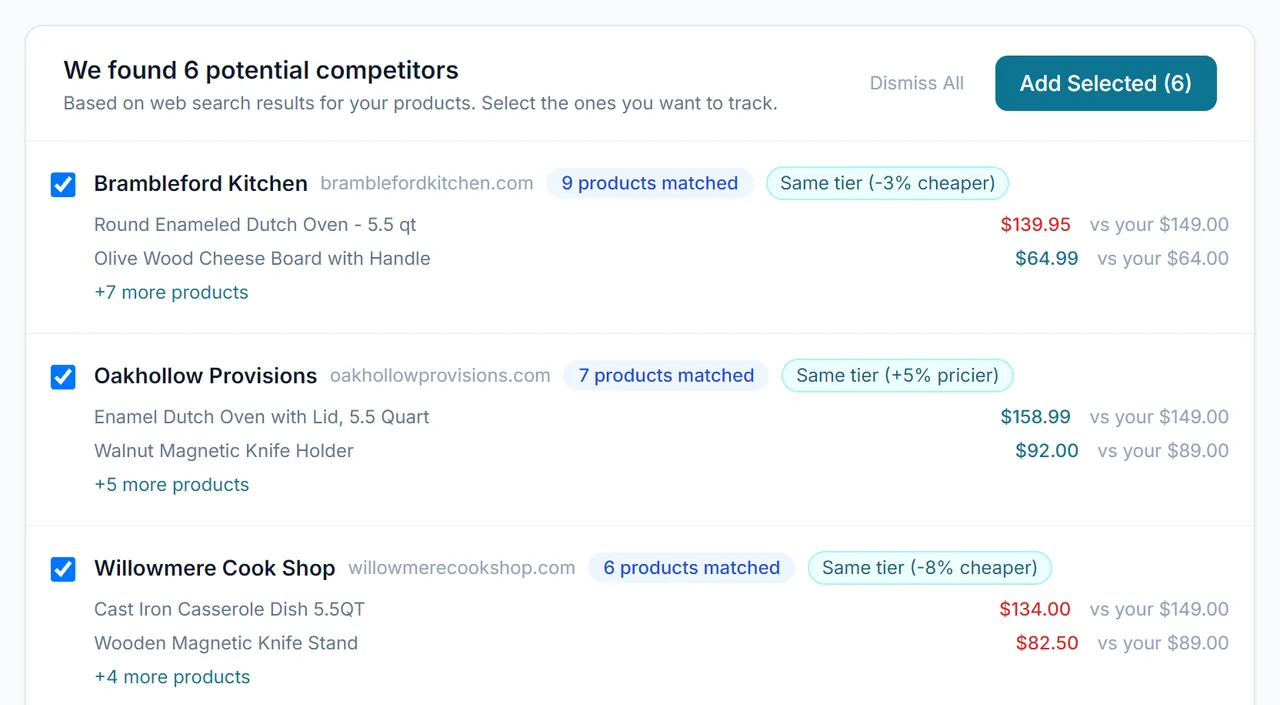
You import your catalogue by store URL (it reads Shopify, WooCommerce and sitemap-based stores) or by CSV. PriceSway then searches stores across the web for each of your products, within a price band of roughly half to double your price. Merchants that keep showing up across your products are suggested as competitors, ranked by how many of your products they carry. When the match is clear, it starts you off tracking up to 3 of the closest, once, and you can remove or swap them. Each suggestion shows the matched products and prices behind it, so you can judge the evidence.
Tracked prices are re-checked about once a day, with full price history and flags for failing checks. Changes arrive as one daily digest email covering moves above your threshold (10% by default), plus when you become or stop being the cheapest, competitor markdowns, stock changes, new sellers and upcoming sale days. You can download 90 days of competitor price history as CSV.
Instead of repricing rules, it recommends prices. The model estimates how your customers respond to price from your own sales history, starting from a labelled reference estimate until you have enough sales. Each recommendation shows the expected change in revenue and gross profit with a confidence interval, and never goes below your minimum margin. With thin data it marks the suggestion low-confidence, and with too little data it declines to recommend. The methodology page explains how this works and its limits.
It also includes product research: give it a niche, countries and a price range, and it returns product ideas with a suggested price, competition found online and supplier search links. No store is needed for that.
Where it falls short
- No MAP monitoring.
- No public API.
- Focuses on web stores and product search, not marketplace channel monitoring.
- Checks about once a day, not several times a day.
- Discovery works best on products sold and indexed on the open web. Niche B2B items and products with non-descriptive names match less well.
- No rule-based repricing, by design.
- No free plan.
Pricing
| Plan | Price | Products checked daily | Product research runs a month |
|---|---|---|---|
| Starter | US$49/mo | 250 | 4 |
| Pro | US$99/mo | 500 | 12 |
| Scale | US$199/mo | 1,000 | 30 |
| Enterprise | From US$499/mo, by contact | 2,500 or more | Quoted |
Every plan includes importing up to 5,000 products, 100 tracked competitors, discovery on 100 products per run, the daily digest and price recommendations. Pro and Scale get support emails answered first; Scale adds setup help by email. There are no per-URL fees and no paid add-ons for matching. The 3-day free trial asks for a card as the last step of signing up, charges nothing during the trial, and sends an email the day before it ends.
Who it suits
Owner-run stores that do not have a competitor list, do not want to hunt for URLs, and want help deciding what price to set rather than only seeing what changed.
Prisync
Prisync is a mature competitor price tracking software platform. You bring the competitor product URLs or configure sales channels, and it monitors them.
What it does well
- Monitoring across URL-based, marketplace channel and hybrid models.
- Large catalogues, with tiers up to 5,000 products and custom plans above.
- URL-plan products checked up to 3 times a day; channel products daily.
- A rule-based repricing engine for hands-off price changes.
- API access, at extra cost.
Where it falls short for small stores
Finding competitors and their matching product pages is your job before monitoring starts. Repricing is rule-based, so it does not account for how your own customers respond to price. Plans are per-product tiers, so you pay for capacity whether you use it or not.
Pricing (checked November 2026)
- URL-based: Professional $99/mo (100 products), Premium $199/mo (1,000), Platinum $399/mo (5,000).
- Channel-based plans from $199/mo; hybrid from $299/mo.
- API access adds 20% to the subscription.
- Extra sales channels $100-200/mo each.
- 14-day free trial, no card required.
Who it suits
Stores with thousands of products across marketplaces that want automatic rule-based repricing, and that already know which competitors to watch. The longer, no-card trial is also a plus. More detail in PriceSway vs Prisync.
Priceva
Priceva monitors the competitor sites you configure, with formula-based repricing. It is the only tool here with a real free plan.
What it does well
- A free Starter plan covering up to 20 products and 20 competitor sites.
- Broad site coverage, with availability and discount tracking.
- MAP monitoring.
- Custom repricing formulas that react to competitor moves.
- High check volumes on paid tiers.
Where it falls short for small stores
You decide which sites to watch. Product matching is manual, or paid: auto-matching by product codes is an add-on priced per site, and assisted matching is billed per match. Those costs grow with every competitor you add. Formulas, like rules, encode your guess about customer behaviour.
Pricing (checked November 2026)
- Starter: free, up to 20 products, 20 competitor sites, 6,200 checks a month.
- Business: $99/mo, unlimited products, 30 sites, 35,000 checks.
- Pro: $199/mo, 40 sites, 100,000 checks. Enterprise is custom.
- Add-ons: extra sites $2.50 per site, auto-matching from $25 per site, assisted matching $0.10 per match.
- No standard self-serve trial listed; demo or pilot on request.
Who it suits
A small store with a short product list and a known set of competitor sites, which can start on the free tier and match products by hand. Also brands that need MAP monitoring, or stores that want formula repricing across a long, known site list. More detail in PriceSway vs Priceva.
Price2Spy
Price2Spy is deep, configurable URL monitoring built for serious volume.
What it does well
- Up to 8 price checks a day on top tiers.
- MAP monitoring with screenshot capture for enforcement evidence.
- Marketplace monitoring from the Basic tier up, and stealth-IP scraping for hard-to-reach sites.
- Enterprise features: custom reports, multiple user seats, API on Premium.
Where it falls short for small stores
You assemble the URL list yourself, with automatch available as a paid add-on. The output is monitoring data, so deciding what to do stays your analysis, and the repricing module is sold separately. Prices are not published, so you cannot work out your cost without a quote.
Pricing (checked November 2026)
- Three tiers: Starter, Basic and Premium. Prices are not published; quotes scale with the number of monitored URLs.
- Starter: self-serve monitoring, up to 10 competitors, no dedicated support.
- Premium adds API, 8 checks a day, 3 user seats and 5 custom reports.
- Add-ons billed separately: repricing module, screenshots, automatch, GA4 integration, stealth IPs, extra users and reports.
- Free trial on Starter and Basic.
Who it suits
Brands enforcing MAP across many resellers, and larger teams that need screenshot evidence, marketplace monitoring at volume and thousands of monitored URLs. For a small retailer it is often more tool than needed, but if you need its depth, nothing else here matches it. More detail in PriceSway vs Price2Spy.
What a 200-product store might pay
Headline prices only tell part of the story. Here is how the published plans line up for a store with 200 products, using the pricing listed in November 2026:
- PriceSway: Starter at US$49/mo covers 250 products checked daily, with discovery and matching included.
- Prisync: Professional covers 100 products, so 200 products needs Premium at $199/mo on the URL-based plans. Add 20% if you want the API.
- Priceva: the free tier stops at 20 products, so you need Business at $99/mo. If you want auto-matching, add from $25 per competitor site.
- Price2Spy: you need a quote, plus any add-ons such as automatch or the repricing module.
At this size the gap is real. At thousands of products across marketplaces, or for MAP programmes, the comparison changes and the rivals' extra breadth may be worth paying for.
Which tool fits which store
- Tiny catalogue, competitor list already known, no budget: Priceva's free plan.
- No competitor list yet, and no time to build one: PriceSway, since discovery is automatic.
- Want a suggested price, not just alerts: PriceSway.
- Thousands of SKUs on marketplaces, want automatic rules: Prisync.
- Need MAP monitoring: Priceva or Price2Spy.
- Need screenshot evidence or several checks a day at volume: Price2Spy.
- Want a long trial without entering a card: Prisync's 14-day trial.
Our comparison hub has the head-to-heads in one place.
Before you sign up for anything
A few steps make any ecommerce price monitoring trial more useful:
- List your competitors by hand first. Search for five of your best-selling products and note which stores keep appearing. Even if you pick a tool that finds competitors for you, this gives you something to check its results against.
- Decide what you will do with the data. Write down when you would match a price, when you would ignore a cut, and your minimum margin. A tool without a plan just produces emails. Our competitor price monitoring guide covers how to react without starting a price war.
- Count your real numbers. Products you want watched, competitors per product, and how often you would actually act. Price each tool against those, add-ons included.
- Use the trial on your own catalogue. Import your real products on day one. A short trial is enough if you start straight away.
- Check the rival's current pricing page. Ours was checked in November 2026; plans and add-ons change.
If you want to look before committing, our free pricing audit shows your store's price structure from a URL, with no account needed. And if you are not ready for any tool, this guide to tracking competitor prices covers manual checks and spreadsheets, with their real costs.
Frequently asked questions
Is there a free competitor price monitoring tool?
Of the four tools here, only Priceva has a free plan, covering up to 20 products and 20 competitor sites with manual matching, as listed in November 2026. Prisync offers a 14-day trial with no card, Price2Spy has a free trial on its Starter and Basic tiers, and PriceSway has a 3-day free trial but no free plan.
Do I have to give the tool my competitors' URLs?
With Prisync, Priceva and Price2Spy, yes - you supply the competitor URLs or sites, and matching is either your job or a paid add-on. PriceSway finds competitors automatically by searching the web for your own products, and you can remove or add stores afterwards.
How often should competitor prices be checked?
A daily check catches lasting price changes, sales and stock changes, which is enough for a store selling on its own site. Pay for several checks a day only if your competitors reprice within the day and you will act that fast.
Which tool should I use for MAP monitoring?
Priceva and Price2Spy both offer MAP monitoring, and Price2Spy adds screenshot capture for enforcement evidence. PriceSway does not do MAP monitoring.
Do these tools only work with Shopify?
No. PriceSway imports from Shopify, WooCommerce and sitemap-based stores by URL, or from a CSV, so it works with any platform. The other tools monitor competitor URLs or sites you give them, so your own platform matters less for them.